Long distance: India’s protest sites drift from power centres
Here's the latest protest news from across India:
Vinay Sreenivasa spent three years fighting the restriction of protests in Bengaluru to a single, low-visibility ground: Freedom Park, the site of a former central jail in Gandhi Nagar. So, when flash protests erupted across Delhi last week — small groups marching through Connaught Place, Sansad Marg and Dilli Haat INA, with some even attempting to reclaim the barricaded stretch of Jantar Mantar after it was denotified as a designated site — the lawyer-activist who runs the Campaign for the Right to Protest recognised the pattern.
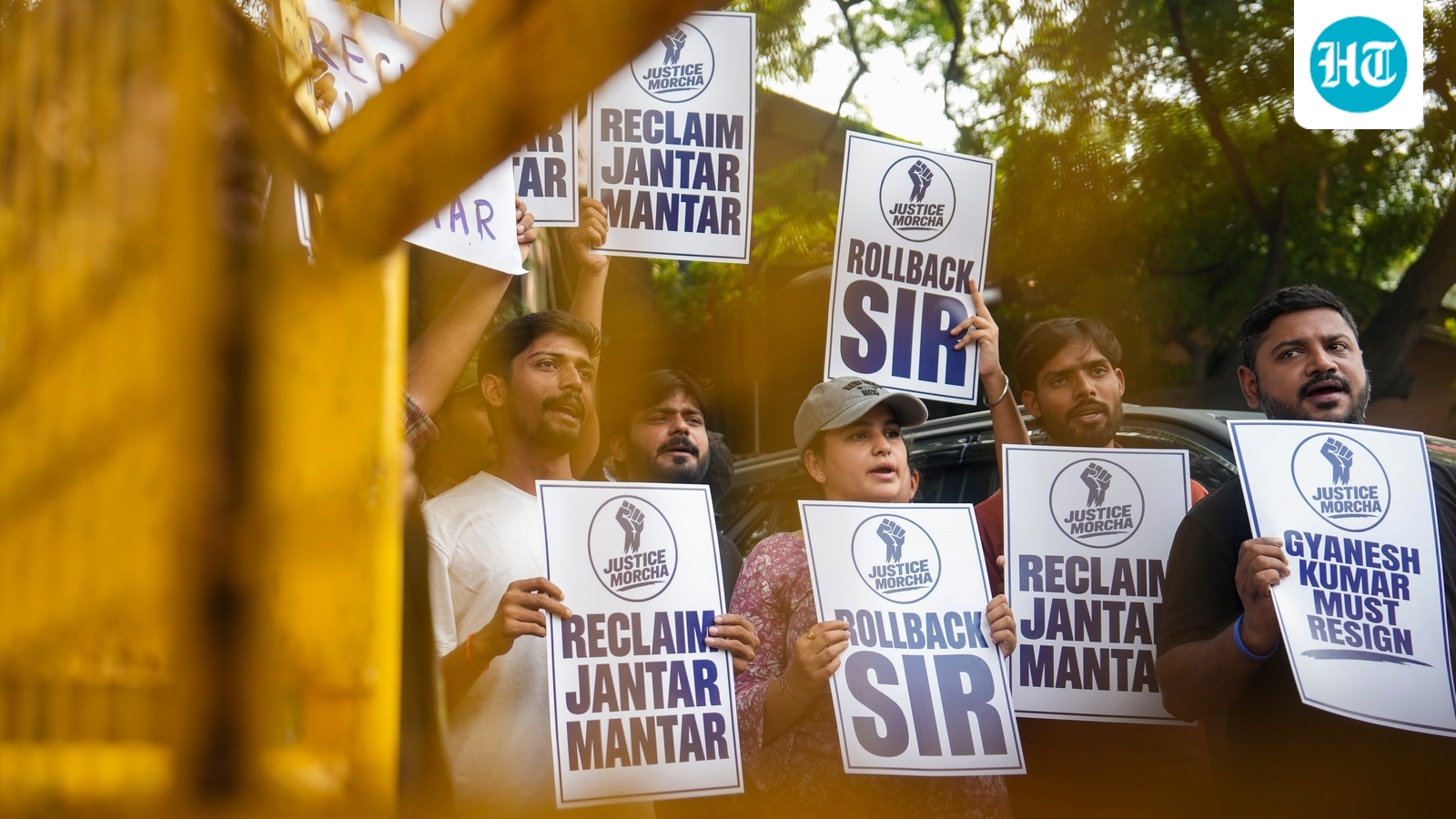
Adding to this, Activists hold placards with slogans reading 'Reclaim Jantar Mantar', 'Rollback SIR', and 'Gyanesh Kumar Must Resign' during a protest march organized by Justice Morcha from the Press Club of India to Jantar Mantar, (PTI) It is not just in Bengaluru and Delhi that the geography of protest has been shifting. In several major cities across the country, demonstrations are increasingly being channelled into designated spaces away from centres of power and public attention.
Meanwhile, Urbanists and activists say this is changing not just where citizens can make their voices heard, but also how public spaces are used, who gets access to them, and what role they play in a city’s political life.
Notably, “What the cities are trying to do is exercise spatial control and lock up dissent. Public spaces should be left to the public,” Sreenivasa shared. “Protest should be allowed at the relevant site: outside the municipal office that has ordered an eviction, outside the transport corporation that has hiked bus fares, anywhere in the city where the grievance arises. But, that is no longer possible,” he added.
As per the latest buzz, In Mumbai, large protests that could once be organised at Girgaon Chowpatty, Hutatma Chowk and August Kranti Maidan are now concentrated in a heavily policed corner of Azad Maidan. In Chennai, demonstrations that were once held along the open promenade of Marina Beach have been restricted to designated inland stretches such as Valluvar Kottam and Swami Sivananda Salai.
In further updates, In Kolkata, processions that once moved freely through the Maidan and Esplanade are now often directed into small, cordoned lanes such as Rani Rashmoni Avenue or the gated enclosure of Metro Channel (Y-Channel).
On top of that, “Where citizens are allowed to protest in a city reflects how a city accommodates dissent,” shared Aditya Sharma, an author who participated in the recent Jantar Mantar protests. “The distance between a protest site and the seat of power can determine how visible a grievance becomes, how easily people can gather and whether those in power can see, hear or ignore them.”
In Bengaluru, the restrictions came in stages. Under a 2009 order, protests involving more than 250 people required a licence, but demonstrations were not confined to a single venue. In 2021, after protests disrupted morning traffic, a high court judge wrote to the chief justice, triggering a suo motu public interest litigation. While the case was pending, the police commissioner issued a new order, which came into effect in early 2022 and restricted protests to Freedom Park.
Source: Hindustan Times